Skip to content
World Broadband Association: Broadband Industry | Global TelecomWorld Broadband Association brings together cloud and broadband industry ecosystem of service providers, vendors, government, policymakers, OTT players to shape the future of global broadband.
  • About
  • News
    • WBBA Barcelona Seminar 2023 Held Successfully
    • Former China Telecommunications Corporation CEO elected as World Broadband Association Board Chairman
    • WBBA Convenes Broadband Industry Stakeholders from Across the Globe for Annual Event 2022
    • Former TM Forum President & CEO, Martin Creaner, appointed as Director General of the World Broadband Association
  • Blog
  • Principles
  • Members
  • Leadership
  • Resources
  • Careers

Markus Reber

Chip Strange

Pa Touray

  • Previous
  • 1
  • 2

Find Out More information About the WBBA Initiative

Find out the latest news about the World Broadband Association including news articles, news releases, the WBBA Member Blog and Member Spotlight Series, plus links to our social media channels and WBBA press office contact details.

MEMBERSHIP ENQUIRIES
World Broadband Association: Broadband Industry | Global Telecom
  • About
  • Working Groups
  • Events
  • News
  • Awards
  • About
  • Working Groups
  • Events
  • News
  • Awards
Knowledge Center
Youtube Linkedin

This website is owned and operated by World Broadband Association (WBBA), an independent, Swiss-registered multilateral broadband industry association. All copyright resides with WBBA. World Broadband Association’s registered office is c/o FORVIS MAZARS SA, 2 Chem. de Blandonnet, Vernier, Genève 1214, Switzerland.| Privacy Policy | Cookie Policy | Terms and Conditions

Contact Us

Sign Up to Receive News Updates

    Have a question about membership, working groups, or WBBA more broadly? We’d love to hear from you. 

    Email us at [email protected] and we’ll get back to you shortly.

  • Driving the Broadband Business Investment Case
  • Maximizing Socioeconomic Benefits
  • The Current Network Status
  • Best Practices for Government Support
  • The Role of the WBBA Can Provide Supporting Further Investment
×
  • Driving the Broadband Business Investment Case
  • Maximizing Socioeconomic Benefits
  • The Current Network Status
  • Best Practices for Government Support
  • The Role of the WBBA Can Provide Supporting Further Investment
Key Messages
Key Messages
Recommendations
Recommendations
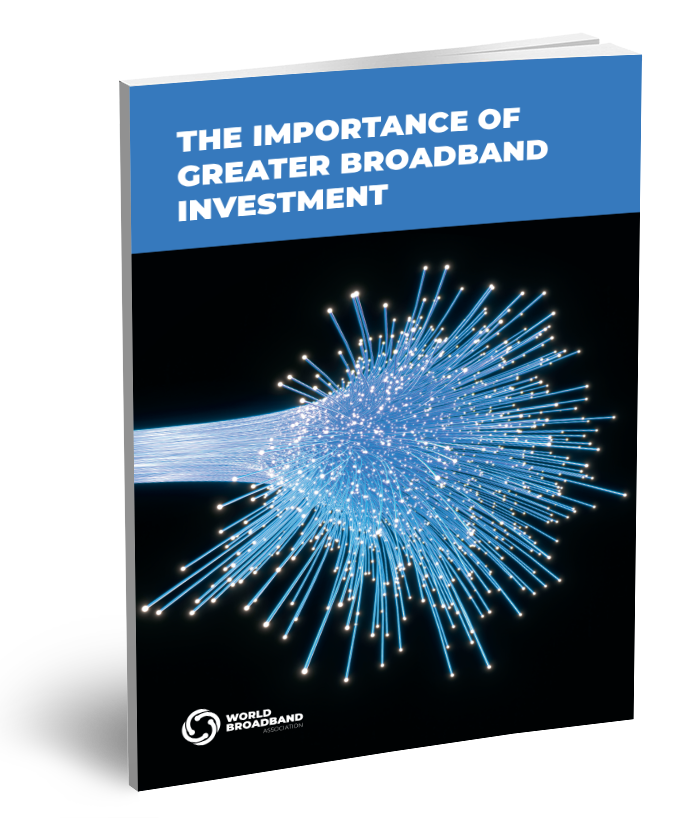
The Importance of Greater Broadband Investment​
Download White Paper

Key Messages

Basic connectivity is not enough. Unlike other utilities such as electricity, broadband has a quality element to it that dictates what and how that connection can be used.
Advanced cloud technology together with superior end-to-end connectivity can enable a wider and more sophisticated range of applications that can in turn drive greater innovation, efficiency, and wealth.
The demand from business for greater broadband service capability therefore continues unabated.
Both enterprises and broader industry ecosystems are actively looking at broadband’s role in enabling their digital transformation. Most respondents to the WBBA’s Thought Leadership Enterprise Survey stated that they need faster and more reliable internet to run their business applications.
All of the main types of broadband access technology have developed significantly over the years and are all now capable of delivering multiple 100s of megabits per second.
Certainly, in the short to medium term, xDSL, cable modem, fixed-wireless access (FWA), and satellite are all expected to have a role in the delivery of broadband services. However, full-fiber access will always deliver the optimum experience and remains the most sustainable and cost-efficient option.
Deploying new, full-fiber networks is an expensive business and the cost per premise connected can grow exponentially as projects move into more rural, harder-to-reach communities.
There is a danger therefore for governments to base their cost-benefit analysis on a national economic view. However, such analysis will miss all the social benefits, as well as the more local economic benefits, that advanced broadband networks can bring. Governments must take all benefits into account, including more localized ones, when creating national broadband policies.
Fiber optic technology is well known for its bandwidth capabilities, in both the downstream and upstream direction.
However, future applications will not only need ultra-high-speed services but also ultra-low latency and jitter, with high levels of reliability and consistency if they are to function properly. Countries with networks that are not capable of meeting such criteria will be left behind as the world moves to the next phase of internet applications such as the “metaverse.”
As well as delivering greater service experience, full-fiber networks can help countries move toward a more environmentally friendly world.
Fiber networks are significantly more environmentally friendly than equivalent copper-based networks, and can help support other green initiatives such as greater working from home, the use of advanced videoconferencing, etc. Fiber-based networks also require less maintenance due to there being less active equipment in the field, and can therefore reduce operators’ operational costs.
To fully exploit the potential of advanced broadband networks, the huge amount of address made available by IPv6 is needed.
With rollout of new access technologies like 5G and Fiber, IPv6 reached more than 30% penetration worldwide (APNIC) and is rapidly growing. IPv6 Enhanced technologies, including segment routing over IPv6, per flow monitoring and AI, enable a multitude of objects and people to be flexibly connected to the proper services, granting end-to-end quality of experience.
Today, the average fiber-to-the-premise (FTTP) coverage across the 81 countries covered in Omdia’s Fiber Development Index is 43%.
Based on the responses from the WBBA Thought Leadership Survey, respondents believed, on average, this coverage could be expanded to approximately 70% through private investment. It is clear that government support will be needed to get to 100%.
The cost of rollout is still seen as the number one barrier to fiber deployment.
However, a lack of data on the available infrastructure, access to key infrastructure such as ducts and in-building networks, and a lack of understanding both internally and externally are also key barriers to further investment.
Governments and other organizations can help service providers in numerous ways to encourage greater fiber investment beyond just financial incentives.
Respondents to the WBBA survey stated that a reduction in regulatory barriers, greater flexibility in partnership arrangements, copper switch-off regulations, and setting out minimum service standards for network installations, would all take priority over financial support.

Recommendations

All countries must look to maximize the potential of broadband. This means creating long-term national broadband plans that evolve around three basic phases of broadband adoption:

  • Phase 1: Fast deployment of basic connectivity (most likely focusing on wireless technologies)
  • Phase 2: Continued rollout of fixed-broadband access to 100% of premises
  • Phase 3: Continued investment in advanced broadband technologies to move to gigabit societies and beyond.

In order to help facilitate this evolution to advanced broadband networks, government organizations and regulators must consider:

  • Implementing regulatory flexibility, including the removal of outdated or non-essential regulation
  • Introducing flexibility in partnership arrangements; for example, allowing agreements between players, such as co-financing, collaborative models, public-private partnerships, etc.
  • Facilitating deployment through municipality approvals, using existing resources (government buildings, streetlights, ducts, etc.) and sharing infrastructure and facilities, including in-building networks. This should also include other types of utility infrastructure where possible
  • Providing financial assistance through investment support, incentives, and subsidies; e.g., universal service funds
  • Improving access to telecom facilities and physical infrastructure; improving procedures for rights of way and accessing public infrastructure, as well as broadband mapping.
Making the Recommendations a Reality

Operators, enterprises, vendors, regulators, and policy-makers should seek to create a collective voice, to evangelize, advocate, co-create, and partner in the drive toward the provision of ultra-broadband networks and services for all. Organizations such as the WBBA can help by influencing key stakeholders through discussion, education, and promotion. Specifically, the WBBA should aim to:

  • Set out the importance of greater broadband investment, not just for the good of the service provider but for countries as a whole
  • Promote regulatory, legislative, public relations agendas that help advance the interests of members through WBBA publications and live events, highlighting best-practice business models from around the world to remove any “lack of understanding at boardroom level”
  • Influence through research, discussion, and promotion of new potential marketing or naming concepts for fixed broadband to ease mass-market understanding of the different generations of broadband access – hiding technical jargon such as “Mbps,” “latency,” and “jitter” from the customer
  • Through thought leadership, media activity, and live events, continue to make the case for what governments need to recognize and do to close the industry innovation, socioeconomic, and environmental benefit gaps through infrastructure investment
  • Explore through new research the challenges and opportunities arising from changes in the industry structure, addressing its impact on the business and the standardization landscape. This includes aspects of fiber wholesale, the move toward horizontal industry structure with separation of infrastructure and services, and the change of customer relationship to digital
  • Work with stakeholder partners to understand and promote the potential of future applications that will bring new benefits to broadband customers and wider society
  • Develop in-depth thought-leadership research on the new revenue opportunities advanced networks can provide to service providers in both the consumer and enterprise markets
  • Develop and highlight best-practice investment models that show the true return on investment of a full-fiber rollout to both private companies and government organizations
  • Champion the needs of its members to highlight barriers to future investment, creating a platform to enable open discussion between different types of stakeholder to encourage greater cooperation and new partnerships.
Martin Creaner
Director General of the World Broadband Association

Martin Creaner is one of the leading strategic thinkers in the global communications industry with a successful career as an executive with Motorola and British Telecom, as well as over a decade as President and CEO of the TM Forum.

Martin currently advises the boards of a number of companies in the communications and high tech industries, ranging from up-and-coming digital economy companies, to market leaders.

Martin has been named among the 25 Most Influential People in Telecom Software by Billing World and has twice been named as one of Global Telecoms Business’ Top 100. Martin holds a Master of Business Administration from Cranfield University, Cranfield School of Management; a Master of Science in Telecommunications from the University of East Anglia; and Bachelor’s degrees in Engineering and Physics from Dublin City University and the University College Dublin, respectively.

Martin is also a recognized thought-leader on digital transformation and the trends of the emerging digital economy. His most recent book “Transforming the Telco” explains the opportunities and challenges that digital transformation presents and outlines how the Telco might navigate this difficult process.

Previous books include “Delivering the Digital Economy”, which outlines the dynamics of the digital economy, and “Frameworx Distilled” & “NGOSS Distilled”, which provide a detailed guidebook to the standards that underpin the Telecom software industry.

Martin was appointed unanimously to the role of Director General by WBBA members.

Martin lives in Cork, Ireland.

Li Zhengmao
Doctor of Engineering, Professor, WBBA Board Chairman

Li Zhengmao, Doctor of Engineering, Professor. He was awarded the title of “Chinese Doctors with Outstanding Contribution” by the Academic Degrees Committee of the State Council & the former State Education Commission, and granted the China Youth Science and Technology Award by the China Association for Science and Technology, and the 2017 Distinguished Industry Leader Award by IEEE; he was inducted into the 2020 IPv6 Internet Hall of Fame and enjoyed special government allowances.

Li served as Vice-Chairman of China Institute of Communications, Vice President of Internet Society of China, Vice-Chairman of the Association of Communications Across the Taiwan Straits, Vice-Chairman of All-China Environment Federation, Board member of GSM Association (GSMA), Board Director of Next Generation Mobile Networks (NGMN) Alliance, Executive Director of Global TD-LTE Initiative (GTI), Vice President of China United Communications Corporation Limited, Vice President of China Mobile Communications Corporation Limited, and President of China Telecommunications Corporation Limited.

Membership Enquiries

[gravityform id="3" title="false"]

Testing New Form

WANT TO see what wbba membership could do for you?


Leave your details and we'll send you more on how membership works, what's included, and how to join.

Members

China Telecom Corporation Limited (“China Telecom” or the “Company”, a joint stock limited company incorporated in the People’s Republic of China with limited liability, together with its subsidiaries, collectively the “Group”) is a large-scale and leading integrated intelligent information services operator in the world, providing wireline & mobile telecommunications services, Internet access services, information services and other value-added telecommunications services primarily in the PRC.

As at the end of 2020, the Company had mobile subscribers of about 351 million, wireline broadband subscribers of about 159 million and access lines in service of about 108 million. The Company’s H shares are listed on the Main Board of The Stock Exchange of Hong Kong Limited (the “Hong Kong Stock Exchange” or “HKSE”).

Members
Founded in 1987, Huawei is a leading global provider of information and communications technology (ICT) infrastructure and smart devices. We have approximately 197,000 employees and we operate in over 170 countries and regions, serving more than three billion people around the world.

Huawei’s mission is to bring digital to every person, home and organization for a fully connected, intelligent world. To this end, we will: drive ubiquitous connectivity and promote equal access to networks to lay the foundation for the intelligent world; provide the ultimate computing power to deliver ubiquitous cloud and intelligence; build powerful digital platforms to help all industries and organizations become more agile, efficient, and dynamic; redefine user experience with AI, offering consumers more personalized and intelligent experiences across all scenarios, including home, travel, office, entertainment, and fitness & health.

Members

At Nokia, we create technology that helps the world act together.

The world is facing fundamental challenges. Pressure on the planet is increasing, productivity is stalling and access to opportunity remains stubbornly unequal. Technology is central to the solution.

Through technology leadership and trusted partnerships, we deliver critical networks to help address global issues.  We have the power to bring together the world’s people, machines and devices, sensing and acting in real time at massive scale. Our critical networks go beyond connectivity to enable self-optimizing, intelligent systems both locally and globally.

With our customers we deliver solutions that respond to climate change through more efficient use and re-use of the world’s resources, restore productivity growth by bringing digital to the physical industries it has not yet reached and provide more inclusive access globally to work, healthcare and education.

We create meaningful interactions to drive human progress.

Members

The technology world as we know it, is changing faster than ever. In a dynamic and complex landscape, the stakes are high, and the challenges and opportunities are real.

At the start of 2020 we formed Omdia by unifying the depth and breadth of expertise from Informa Tech’s legacy research brands: Ovum, IHS Markit Technology, Tractica and Heavy Reading. This empowered us to serve the technology industry like never before.

Today, we help organizations make better technology choices for their business and enable technology innovators to better understand and reach the markets they hope to serve.

Members

Swisscom is Switzerland’s leading telecom provider and one of its foremost IT companies, headquartered in Ittigen, close to the capital city, Bern. Its subsidiary Fastweb has built up a strong position on the Italian market. Swisscom brooks no compromise when it comes to serving customer needs; it focuses on service and quality and invests massively in the networks of the future.

Members

Openreach Limited runs the UK’s digital network. We’re the people who connect homes, schools, hospitals, libraries, businesses – large and small, broadcasters and governments to the world. It’s our mission to build the best possible network with the highest quality of service, and make sure that everyone in the UK can be connected. We’re a wholly owned subsidiary of BT Group and our customers are the 650+ communications providers who sell phone, broadband and Ethernet services to homes and businesses.

Openreach is made up of four divisions – service delivery, fibre and network delivery, strategic infrastructure development, and headquarters.

Our 35,000 people are hugely experienced, resourceful and innovative. They tackle complicated engineering problems – from coordinating works with councils, highways agencies, energy suppliers and landowners, to installing and maintaining the complex kit that provides fibre broadband services. They go the extra mile and take on any challenge to build a better, faster and more affordable network that helps our customers stay connected.