

Skip to content
News Releases
October 14, 2024
"In her welcome speech, Alexia Gonzalez Fanfalone, Head of the Connectivity Services and Infrastructures Unit at OECD, delivered a powerful message on the need to close the global connectivity gap. Alexia emphasized the importance of building resilient, future-proof networks that can support inclusive, sustainable growth. Her remarks served as a call to action, reminding us all that connectivity is key to creating a more prosperous and equitable world. "
Debra Carty
Community Manager

Highlights from the World Broadband Association’s Broadband Development Congress in Paris
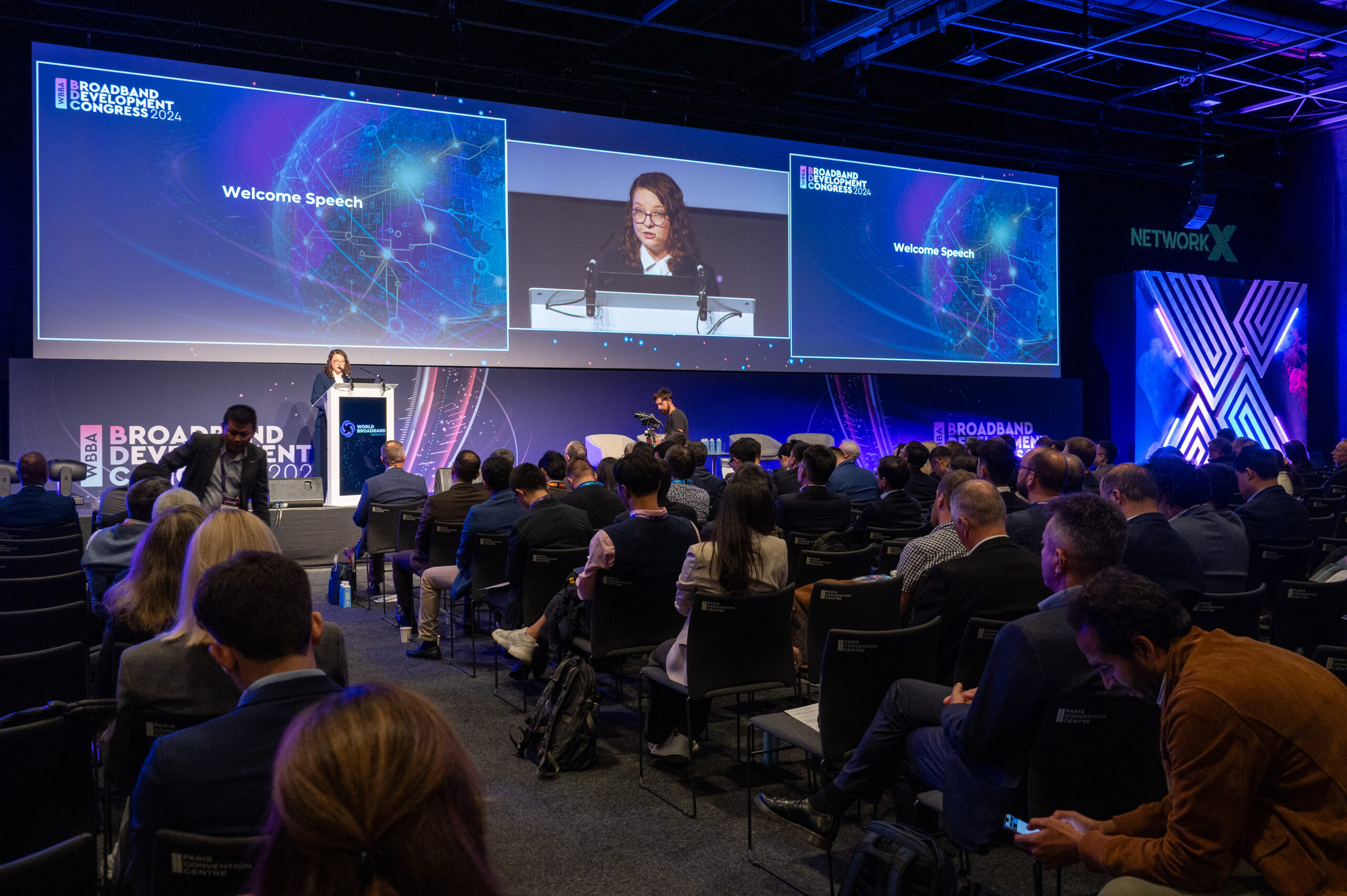
Allo Photo - Claude Sarrabia - www.allophoto.fr
The World Broadband Association’s Broadband Development Congress, held on 8 October in Paris, brought together top industry leaders and innovators. Attendees engaged in insightful discussions, gained key knowledge, and built connections that will shape the future of global broadband.

The World Broadband Association’s (WBBA) Broadband Development Congress, held on 8 October in Paris, was a remarkable gathering of industry leaders, innovators, and visionaries. Attendees had the privilege of participating in thought-provoking discussions, gaining invaluable knowledge, and forming meaningful connections that will undoubtedly shape the future of broadband development. 

Key Takeaways and Networking Opportunities 

The insights shared at the WBBA Broadband Development Congress Paris were nothing short of transformational. From discussions about the future of broadband to the role of AI in shaping next-generation networks, it’s clear that many left the event with fresh strategies and innovative ideas to take back to their organizations. 

Beyond the talks, the networking opportunities were just as impactful. The event served as a hub for fostering new collaborations, with many attendees establishing relationships that will drive future partnerships and advancements in broadband technology. 

Fireside Chat: The Future of Broadband and Cloud 

One of the standout sessions was the Fireside Chat featuring Amaury de Gromard, Head of Networks Strategy & Business Development at Swisscom, Mohamed Amine Benziane of Algeria Telecom, Rickard Damm of Deutsche Telecom and Dr Olivier Ferveur of ETSI.  They shared their views and key insights on the future of broadband and cloud development, highlighting the rapidly evolving landscape and the need for forward-thinking strategies. Their shared vision emphasized the promising role AI will play in enhancing broadband services for both operators and customers. 

The Importance of Collaboration in Broadband 

In his address, Dr. Li Zhengmao, Chairman of the World Broadband Association, spoke passionately about the significance of collaboration in the broadband sector. Dr. Li’s insights underscored the crucial role that partnerships will play in shaping the future of connectivity, stating that working together is essential to driving meaningful change. His message resonated with many attendees, reinforcing the value of cross-industry cooperation to enhance global connectivity. 

AI's Influence on Next-Generation Network Development 

Another highlight of the event was the keynote presentation by Feng Zhishan, President of Optical Access Network Product Line at Huawei. Feng’s address focused on the transformative potential of AI in the broadband industry, offering a glimpse into how AI could redefine connectivity and lead to groundbreaking innovations. His presentation sparked exciting discussions on how AI will power next-generation networks and reshape the broadband experience. 

Closing the Connectivity Gap: A Call for Action 

In her welcome speech, Alexia Gonzalez Fanfalone, Head of the Connectivity Services and Infrastructures Unit at OECD, delivered a powerful message on the need to close the global connectivity gap. Alexia emphasized the importance of building resilient, future-proof networks that can support inclusive, sustainable growth. Her remarks served as a call to action, reminding us all that connectivity is key to creating a more prosperous and equitable world. 

Looking Ahead: The Future of Broadband Development 

As the WBBA Broadband Development Congress concluded, it was clear that the future of broadband is brimming with possibilities. With AI playing an increasingly central role, and with collaboration across sectors, the industry is poised to deliver faster, smarter, and more inclusive networks. 

The knowledge shared and connections made during the event will undoubtedly drive innovation and progress, paving the way for a more connected future for all. 

The event in Paris was not just a platform for discussion, but a springboard for transformative ideas and collaborative partnerships that will shape the broadband landscape for years to come. 

To join our  thriving community click here 

Sign Up to Receive News Updates

Key Messages

Advanced cloud technology together with superior end-to-end connectivity can enable a wider and more sophisticated range of applications that can in turn drive greater innovation, efficiency, and wealth.
Both enterprises and broader industry ecosystems are actively looking at broadband’s role in enabling their digital transformation. Most respondents to the WBBA’s Thought Leadership Enterprise Survey stated that they need faster and more reliable internet to run their business applications.
Certainly, in the short to medium term, xDSL, cable modem, fixed-wireless access (FWA), and satellite are all expected to have a role in the delivery of broadband services. However, full-fiber access will always deliver the optimum experience and remains the most sustainable and cost-efficient option.
There is a danger therefore for governments to base their cost-benefit analysis on a national economic view. However, such analysis will miss all the social benefits, as well as the more local economic benefits, that advanced broadband networks can bring. Governments must take all benefits into account, including more localized ones, when creating national broadband policies.
However, future applications will not only need ultra-high-speed services but also ultra-low latency and jitter, with high levels of reliability and consistency if they are to function properly. Countries with networks that are not capable of meeting such criteria will be left behind as the world moves to the next phase of internet applications such as the “metaverse.”
Fiber networks are significantly more environmentally friendly than equivalent copper-based networks, and can help support other green initiatives such as greater working from home, the use of advanced videoconferencing, etc. Fiber-based networks also require less maintenance due to there being less active equipment in the field, and can therefore reduce operators’ operational costs.
With rollout of new access technologies like 5G and Fiber, IPv6 reached more than 30% penetration worldwide (APNIC) and is rapidly growing. IPv6 Enhanced technologies, including segment routing over IPv6, per flow monitoring and AI, enable a multitude of objects and people to be flexibly connected to the proper services, granting end-to-end quality of experience.
Based on the responses from the WBBA Thought Leadership Survey, respondents believed, on average, this coverage could be expanded to approximately 70% through private investment. It is clear that government support will be needed to get to 100%.
However, a lack of data on the available infrastructure, access to key infrastructure such as ducts and in-building networks, and a lack of understanding both internally and externally are also key barriers to further investment.
Respondents to the WBBA survey stated that a reduction in regulatory barriers, greater flexibility in partnership arrangements, copper switch-off regulations, and setting out minimum service standards for network installations, would all take priority over financial support.

Recommendations

All countries must look to maximize the potential of broadband. This means creating long-term national broadband plans that evolve around three basic phases of broadband adoption:

In order to help facilitate this evolution to advanced broadband networks, government organizations and regulators must consider:

Making the Recommendations a Reality

Operators, enterprises, vendors, regulators, and policy-makers should seek to create a collective voice, to evangelize, advocate, co-create, and partner in the drive toward the provision of ultra-broadband networks and services for all. Organizations such as the WBBA can help by influencing key stakeholders through discussion, education, and promotion. Specifically, the WBBA should aim to: