

BANGKOK, THAILAND, July 14, 2026 —— At the Asia-Pacific Broadband Development Summit (BDS), the World Broadband Association (WBBA) officially launched AI-Net, a globally authoritative data communications certification for countries and operators worldwide. Serving as a digital infrastructure milestone, the certification provides a strategic guideline for global networks to transition from connectivity-driven architectures to intelligence-driven networks, propelling global infrastructure from the "All-Cloud" era into the "All-Intelligence" era, while accelerating industry-wide generational evolution and intelligent transformation.
Currently, AI is reshaping the global economy, demanding higher carrying capacity, scalability, and intelligence from underlying infrastructure. As industries transition to Net5.5G, traditional metrics like bandwidth and coverage no longer reflect national competitiveness in the intelligent era. Consequently, the WBBA introduced the AI-Net Certification, focusing on three new pillars: national policy guidance, collaborative industry ecosystems, and Net5.5G penetration rate. This highly quantifiable evaluation system aims to accelerate global Net5.5G deployment by aligning top-level policies with industrial ecosystems to systematically benchmark technological maturity.
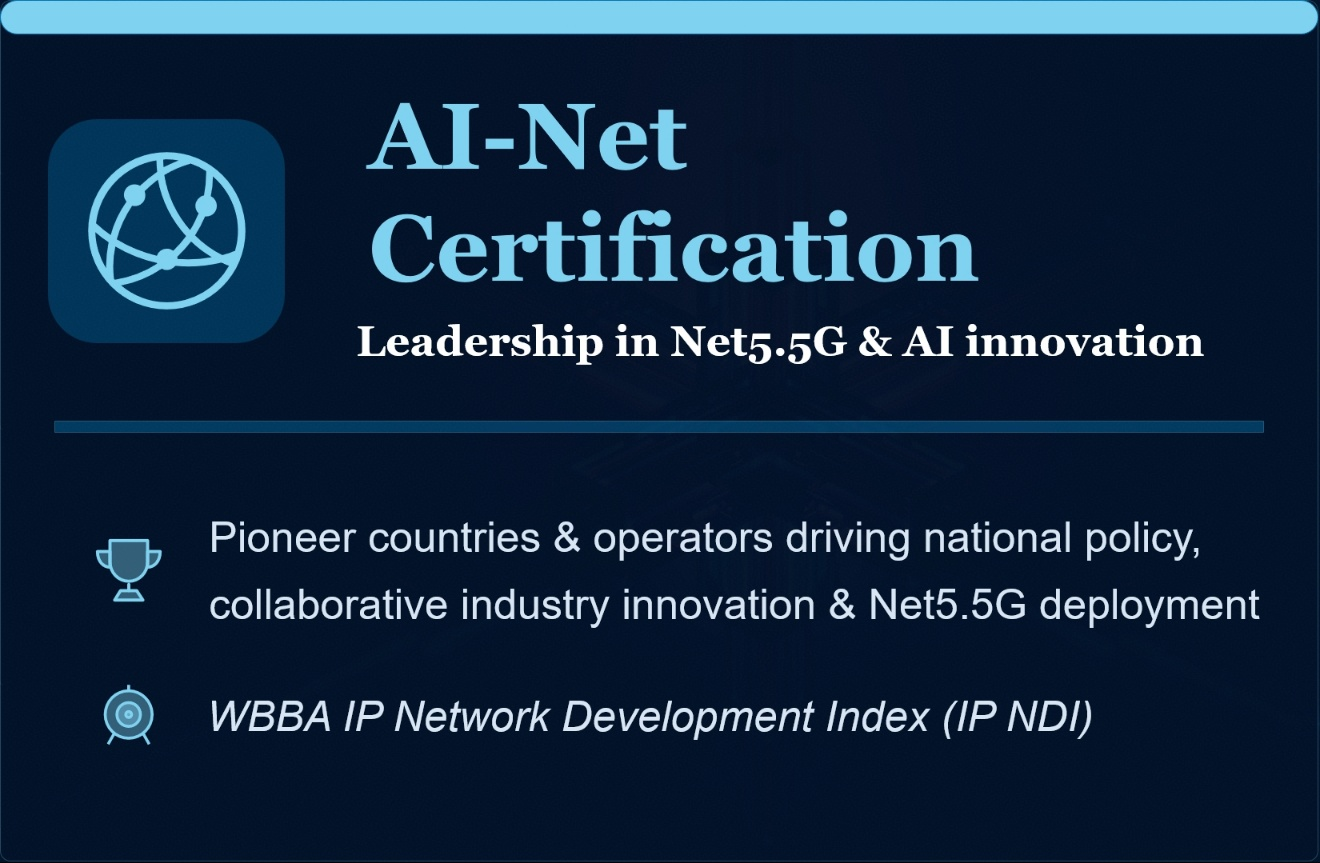
AI-Net Certification
During the launch, the WBBA elaborated on the bidirectional empowerment of the AI-Net Certification, highlighting its dual core values:
First, "Network for AI" establishes networks as the foundational bedrock for intelligent computing rather than mere transmission pipelines. By delivering deterministic performance—characterized by high throughput, zero packet loss, and ultra-low latency—modern network infrastructure fully unleashes the potential of intelligence. This ensures seamless, deep coordination between computing power and network scheduling, providing guaranteed experience quality for elastic demands and optimizing data efficiency for large-scale AI model training and inference.
Second, "AI for Network" injects native intelligence directly into devices and management platforms. By deeply integrating AI capabilities, networks transition from passive routing to active cognitive systems with endogenous intelligence, self-healing, and continuous self-optimization. This structural shift drives infrastructure toward highly automated "Agentic" O&M and AN L4, drastically reducing operational complexity and mitigating maintenance overhead for global operators.
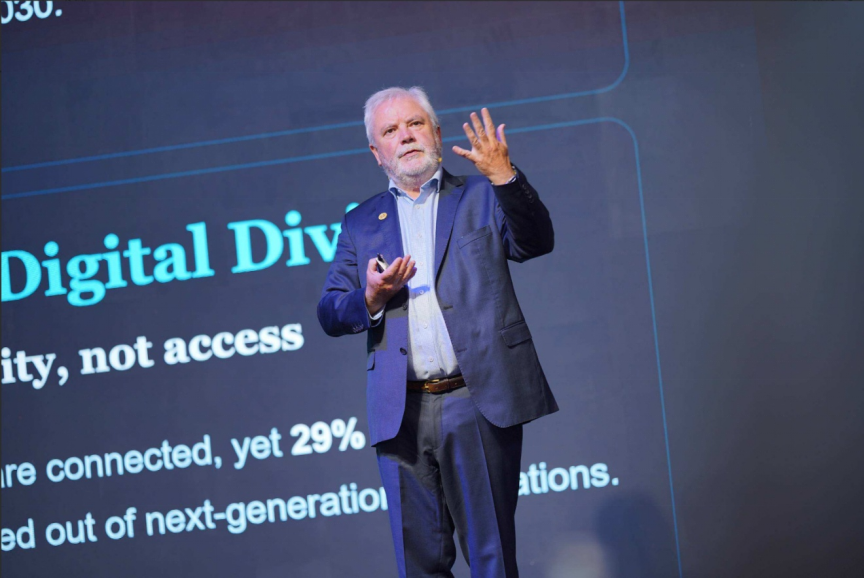
WBBA Director General Martin Creaner elaborating on the AI-Net Certification
The AI-Net assessment spans both macroeconomic and microeconomic dimensions. At the macroeconomic level, the certification evaluates national policy alignment and industry-building efforts. Key criteria include top-level policy frameworks anchoring Net5.5G, IPv6, and intelligent networks, alongside active contributions to global standards and ecosystem collaboration. At the microeconomic level, the assessment benchmarks operators using the IP Network Development Index (IPDI) launched by the WBBA at MWC, precisely measuring live-network intelligence and Advanced IP/Net5.5G deployment density to identify Net5.5G pioneers.
Moving beyond Wide Area Networks, the certification's scope extends to end-to-end digital foundations, integrating highly interconnected Data Center Networks and comprehensive endogenous security systems into its core criteria. This multidimensional alignment not only highlights a nation's strategic foresight but also validates the full-scenario, highly secure network capabilities delivered by leading operators in specialized sectors like automated logistics, smart retail, and smart cities.
"A trusted, industry-recognized benchmark, AI-Net turns the Four Forces into measurable progress toward Network 2030." Moving forward, the WBBA will leverage this certification to build global consensus among policymakers, standards organizations, and leading operators. By accelerating unified standards and closing the digital divide, the initiative will construct an "AI-ready" network foundation to drive industries toward the 2030 intelligent future.
About the World Broadband Association:
The World Broadband Association (WBBA) is an open, multilateral organization and platform that brings together cloud and broadband industry stakeholders to address and drive forward the shared goals of maximizing the social and economic benefits of digital ultra-broadband for all globally. The WBBA champions the business, consumer and citizen outcomes that broadband can deliver across the world, through converged network and cloud infrastructure.