
Skip to content

Governance

At the World Broadband Association, we believe that effective governance is the cornerstone of a successful and thriving organization. Our transparent and well-defined governance structure ensures that our broadband industry innovation goals are met, growth is sustained, and the interests of all stakeholders are diligently safeguarded. The WBBA is governed by its Articles of Association, which can be found here.

The WBBA General Assembly is the Association’s supreme authority and is composed of all the Members, chaired by the WBBA Director-General. It convenes at least once a year to approve Board members and decides on any modification of the Articles of Association, among other matters. The General Assembly operates on a one-Member, one-vote basis.
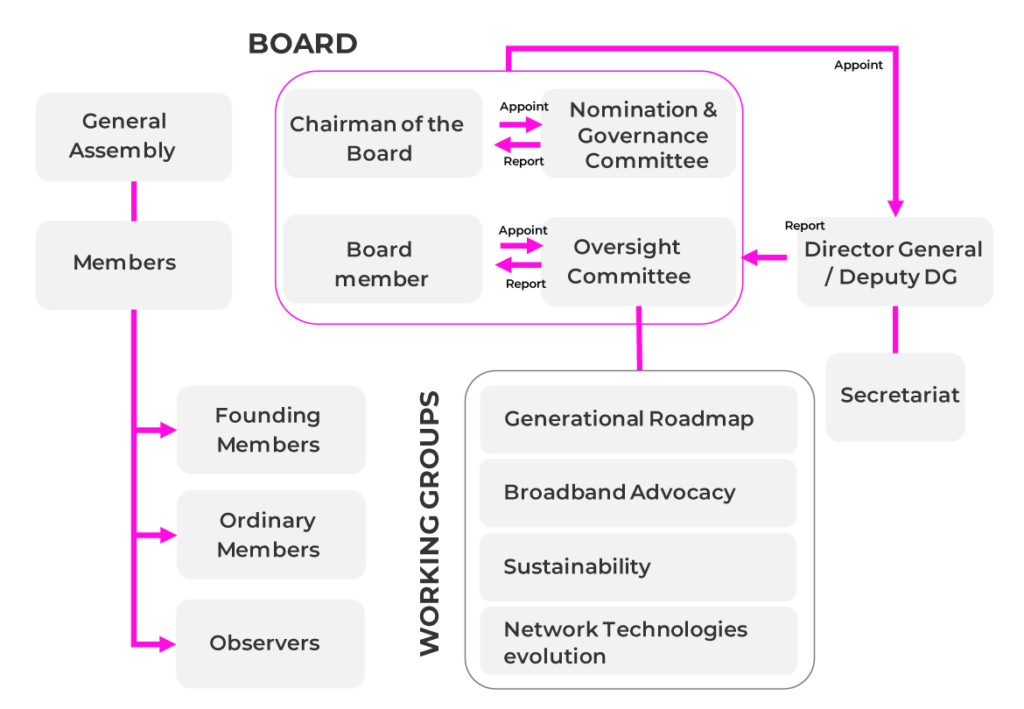
Outside of the General Assembly, all members gather quarterly to receive updates, share insights, and provide vital feedback on the WBBA’s ongoing initiatives. These meetings foster a collaborative environment, enabling diverse perspectives to enrich our strategies and operations. This collective engagement ensures that the WBBA remains aligned with its member’s needs, aspirations, and the Articles of Association.

Board:

The WBBA Board, comprised of distinguished industry leaders, assembles biannually to review the association’s progress, set strategic ideas and goals, for broadband industry innovation and practices, and assess overall growth. Chaired by Li Zhengmao, these meetings contribute to shaping the WBBA’s structure and direction, ensuring its continued relevance and growth.

Oversight Committee:

The Oversight Committee, a monthly gathering with a rotating chairperson nominated from among the members,  to provide oversight of the operation and direction of WBBA on a regular basis on behalf of the Board and to carry out activities as directed by the Board on their behalf. This includes meticulously monitoring the association’s growth and assessing feedback provided by various working groups. This proactive approach guarantees that the WBBA’s initiatives are in harmony with its mission of broadband industry innovation and that all operational aspects are functioning effectively.

Secretariat:

At the heart of the WBBA’s administrative affairs is the WBBA’s Community Manager. The Community Manager plays a pivotal role in ensuring the seamless execution of administrative processes, facilitating communication among different tiers of the organization, and providing essential support to all aspects of the WBBA’s functioning.

Sign Up to Receive News Updates

Membership Enquiries

[gravityform id="3" title="false"]

Testing New Form

Martin Creaner
Director General of the World Broadband Association

Martin Creaner is one of the leading strategic thinkers in the global communications industry with a successful career as an executive with Motorola and British Telecom, as well as over a decade as President and CEO of the TM Forum.

Martin currently advises the boards of a number of companies in the communications and high tech industries, ranging from up-and-coming digital economy companies, to market leaders.

Martin has been named among the 25 Most Influential People in Telecom Software by Billing World and has twice been named as one of Global Telecoms Business’ Top 100. Martin holds a Master of Business Administration from Cranfield University, Cranfield School of Management; a Master of Science in Telecommunications from the University of East Anglia; and Bachelor’s degrees in Engineering and Physics from Dublin City University and the University College Dublin, respectively.

Martin is also a recognized thought-leader on digital transformation and the trends of the emerging digital economy. His most recent book “Transforming the Telco” explains the opportunities and challenges that digital transformation presents and outlines how the Telco might navigate this difficult process.

Previous books include “Delivering the Digital Economy”, which outlines the dynamics of the digital economy, and “Frameworx Distilled” & “NGOSS Distilled”, which provide a detailed guidebook to the standards that underpin the Telecom software industry.

Martin was appointed unanimously to the role of Director General by WBBA members.

Martin lives in Cork, Ireland.

Li Zhengmao
Doctor of Engineering, Professor, WBBA Board Chairman

Li Zhengmao, Doctor of Engineering, Professor. He was awarded the title of “Chinese Doctors with Outstanding Contribution” by the Academic Degrees Committee of the State Council & the former State Education Commission, and granted the China Youth Science and Technology Award by the China Association for Science and Technology, and the 2017 Distinguished Industry Leader Award by IEEE; he was inducted into the 2020 IPv6 Internet Hall of Fame and enjoyed special government allowances.

Li served as Vice-Chairman of China Institute of Communications, Vice President of Internet Society of China, Vice-Chairman of the Association of Communications Across the Taiwan Straits, Vice-Chairman of All-China Environment Federation, Board member of GSM Association (GSMA), Board Director of Next Generation Mobile Networks (NGMN) Alliance, Executive Director of Global TD-LTE Initiative (GTI), Vice President of China United Communications Corporation Limited, Vice President of China Mobile Communications Corporation Limited, and President of China Telecommunications Corporation Limited.

Key Messages

Advanced cloud technology together with superior end-to-end connectivity can enable a wider and more sophisticated range of applications that can in turn drive greater innovation, efficiency, and wealth.
Both enterprises and broader industry ecosystems are actively looking at broadband’s role in enabling their digital transformation. Most respondents to the WBBA’s Thought Leadership Enterprise Survey stated that they need faster and more reliable internet to run their business applications.
Certainly, in the short to medium term, xDSL, cable modem, fixed-wireless access (FWA), and satellite are all expected to have a role in the delivery of broadband services. However, full-fiber access will always deliver the optimum experience and remains the most sustainable and cost-efficient option.
There is a danger therefore for governments to base their cost-benefit analysis on a national economic view. However, such analysis will miss all the social benefits, as well as the more local economic benefits, that advanced broadband networks can bring. Governments must take all benefits into account, including more localized ones, when creating national broadband policies.
However, future applications will not only need ultra-high-speed services but also ultra-low latency and jitter, with high levels of reliability and consistency if they are to function properly. Countries with networks that are not capable of meeting such criteria will be left behind as the world moves to the next phase of internet applications such as the “metaverse.”
Fiber networks are significantly more environmentally friendly than equivalent copper-based networks, and can help support other green initiatives such as greater working from home, the use of advanced videoconferencing, etc. Fiber-based networks also require less maintenance due to there being less active equipment in the field, and can therefore reduce operators’ operational costs.
With rollout of new access technologies like 5G and Fiber, IPv6 reached more than 30% penetration worldwide (APNIC) and is rapidly growing. IPv6 Enhanced technologies, including segment routing over IPv6, per flow monitoring and AI, enable a multitude of objects and people to be flexibly connected to the proper services, granting end-to-end quality of experience.
Based on the responses from the WBBA Thought Leadership Survey, respondents believed, on average, this coverage could be expanded to approximately 70% through private investment. It is clear that government support will be needed to get to 100%.
However, a lack of data on the available infrastructure, access to key infrastructure such as ducts and in-building networks, and a lack of understanding both internally and externally are also key barriers to further investment.
Respondents to the WBBA survey stated that a reduction in regulatory barriers, greater flexibility in partnership arrangements, copper switch-off regulations, and setting out minimum service standards for network installations, would all take priority over financial support.

Recommendations

All countries must look to maximize the potential of broadband. This means creating long-term national broadband plans that evolve around three basic phases of broadband adoption:

In order to help facilitate this evolution to advanced broadband networks, government organizations and regulators must consider:

Making the Recommendations a Reality

Operators, enterprises, vendors, regulators, and policy-makers should seek to create a collective voice, to evangelize, advocate, co-create, and partner in the drive toward the provision of ultra-broadband networks and services for all. Organizations such as the WBBA can help by influencing key stakeholders through discussion, education, and promotion. Specifically, the WBBA should aim to: