
Skip to content
News Releases
May 19, 2025

World Telecommunication and Information Society Day, 17 May 2025
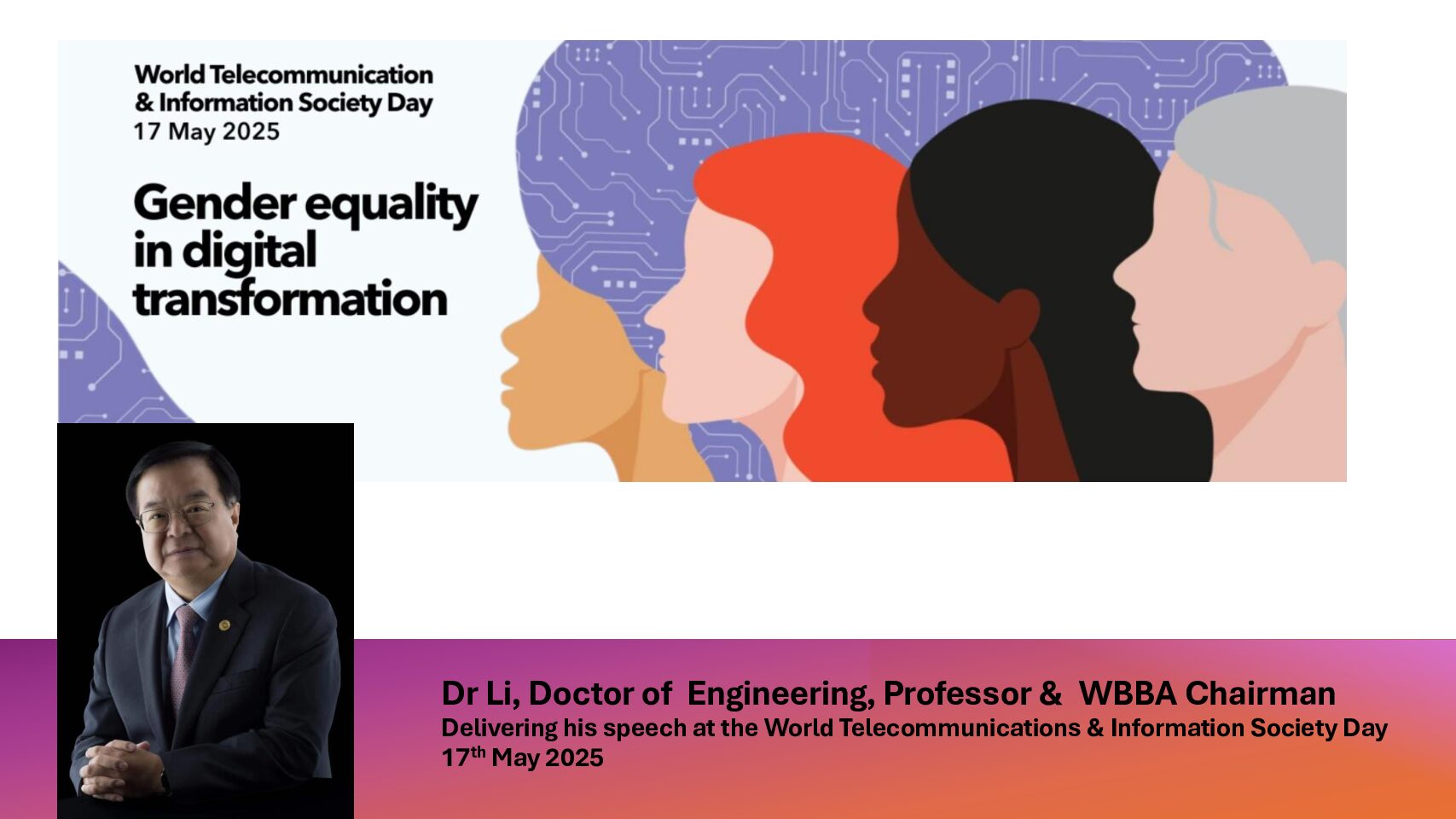
Dr Li, Doctor of Engineering, Professor, 15 May 2025
WBBA chairman, Li Zhengmao presented at the World Telecommunication & Information Society Day on 17th May. We hope you find the speech insightful!

Dear WBBA Board Members, Members, and Industry Friends,

Today, digital transformation is reshaping our lives, work, and social structures at an unprecedented pace. However, gaps in gender, geography, and economics continue to act as invisible barriers to equal internet access, placing women at a disadvantage amid the wave of digitalization. According to data from the International Telecommunication Union, there are 189 million more men than women using the internet, and women represent less than 30% of the workforce in the tech sector. This reveals that women still face challenges in accessing digital resources and that their participation in digital transformation and the digital economy remains limited. Their full potential has yet to be realized.

Gender equality is not only a fundamental requirement of social justice but also a key factor in accelerating progress toward the United Nations Sustainable Development Goals. Achieving gender equality within the context of digital transformation—by encouraging more women to learn, research, and work in ICT, and by providing them with training, mentorship, and support to enhance digital skills and innovation capabilities—holds immeasurable value for driving social progress and promoting sustainable economic development.

Since it was founded in 2022, the WBBA has upheld the principles of openness, inclusiveness, collaboration, and mutual benefit. We are committed to uniting the global industry chain, enhancing communication, strengthening technical cooperation, and promoting high-quality development in the ICT sector. Our membership includes a wide range of industry stakeholders from elecom operators, equipment vendors, vertical industries through to research institutions, all working together to build a more equitable, inclusive, and efficient ICT ecosystem.

In 2024, we hosted the WBBA Broadband Development Congress (BDC) in Africa, where global insights converged to explore how cloud and broadband technologies can reshape Africa’s digital landscape, bridge the digital and intelligence divides, and contribute to a brighter digital future for the continent. This year, the WBBA BDC will take place in São Paulo, South America, to explore how artificial intelligence can lead the next wave of cloud broadband development and accelerate digital transformation in South American nations. Our aim is to provide greater digital opportunities for women in developing countries, advancing the cause of gender equality.

Recently, the WBBA Advisory Committee held its first online meeting with great success. Two new members, Mr. Boris Koprivnikar and Mr. Brahima Sanou, have made outstanding contributions to promoting global digital inclusion and bridging the digital divide. Under the leadership of Mr. Houlin Zhao, former ITU Secretary-General and current Chairman of the WBBA Advisory Committee, we believe this body will further enhance collaboration between the WBBA association and the industry, drive cloud broadband policy development, and help WBBA realize its goal of building a collaborative and innovative cloud broadband ecosystem for all.

We firmly believe that by strengthening infrastructure, promoting technological innovation, and enhancing industry cooperation, more people, regardless of location or gender, can benefit from the convenience and opportunities brought by digital technologies.

Looking ahead, the World Broadband Association will continue to leverage its strengths and work hand-in-hand with global partners to advance the adoption and application of ICT, promote gender equality in the digital transformation, and contribute our wisdom and efforts to the achievement of the UN Sustainable Development Goals.

Sign Up to Receive News Updates

Key Messages

Advanced cloud technology together with superior end-to-end connectivity can enable a wider and more sophisticated range of applications that can in turn drive greater innovation, efficiency, and wealth.
Both enterprises and broader industry ecosystems are actively looking at broadband’s role in enabling their digital transformation. Most respondents to the WBBA’s Thought Leadership Enterprise Survey stated that they need faster and more reliable internet to run their business applications.
Certainly, in the short to medium term, xDSL, cable modem, fixed-wireless access (FWA), and satellite are all expected to have a role in the delivery of broadband services. However, full-fiber access will always deliver the optimum experience and remains the most sustainable and cost-efficient option.
There is a danger therefore for governments to base their cost-benefit analysis on a national economic view. However, such analysis will miss all the social benefits, as well as the more local economic benefits, that advanced broadband networks can bring. Governments must take all benefits into account, including more localized ones, when creating national broadband policies.
However, future applications will not only need ultra-high-speed services but also ultra-low latency and jitter, with high levels of reliability and consistency if they are to function properly. Countries with networks that are not capable of meeting such criteria will be left behind as the world moves to the next phase of internet applications such as the “metaverse.”
Fiber networks are significantly more environmentally friendly than equivalent copper-based networks, and can help support other green initiatives such as greater working from home, the use of advanced videoconferencing, etc. Fiber-based networks also require less maintenance due to there being less active equipment in the field, and can therefore reduce operators’ operational costs.
With rollout of new access technologies like 5G and Fiber, IPv6 reached more than 30% penetration worldwide (APNIC) and is rapidly growing. IPv6 Enhanced technologies, including segment routing over IPv6, per flow monitoring and AI, enable a multitude of objects and people to be flexibly connected to the proper services, granting end-to-end quality of experience.
Based on the responses from the WBBA Thought Leadership Survey, respondents believed, on average, this coverage could be expanded to approximately 70% through private investment. It is clear that government support will be needed to get to 100%.
However, a lack of data on the available infrastructure, access to key infrastructure such as ducts and in-building networks, and a lack of understanding both internally and externally are also key barriers to further investment.
Respondents to the WBBA survey stated that a reduction in regulatory barriers, greater flexibility in partnership arrangements, copper switch-off regulations, and setting out minimum service standards for network installations, would all take priority over financial support.

Recommendations

All countries must look to maximize the potential of broadband. This means creating long-term national broadband plans that evolve around three basic phases of broadband adoption:

In order to help facilitate this evolution to advanced broadband networks, government organizations and regulators must consider:

Making the Recommendations a Reality

Operators, enterprises, vendors, regulators, and policy-makers should seek to create a collective voice, to evangelize, advocate, co-create, and partner in the drive toward the provision of ultra-broadband networks and services for all. Organizations such as the WBBA can help by influencing key stakeholders through discussion, education, and promotion. Specifically, the WBBA should aim to:

Members

China Telecom Corporation Limited (“China Telecom” or the “Company”, a joint stock limited company incorporated in the People’s Republic of China with limited liability, together with its subsidiaries, collectively the “Group”) is a large-scale and leading integrated intelligent information services operator in the world, providing wireline & mobile telecommunications services, Internet access services, information services and other value-added telecommunications services primarily in the PRC.

As at the end of 2020, the Company had mobile subscribers of about 351 million, wireline broadband subscribers of about 159 million and access lines in service of about 108 million. The Company’s H shares are listed on the Main Board of The Stock Exchange of Hong Kong Limited (the “Hong Kong Stock Exchange” or “HKSE”).

Members

Founded in 1987, Huawei is a leading global provider of information and communications technology (ICT) infrastructure and smart devices. We have approximately 197,000 employees and we operate in over 170 countries and regions, serving more than three billion people around the world.

Huawei’s mission is to bring digital to every person, home and organization for a fully connected, intelligent world. To this end, we will: drive ubiquitous connectivity and promote equal access to networks to lay the foundation for the intelligent world; provide the ultimate computing power to deliver ubiquitous cloud and intelligence; build powerful digital platforms to help all industries and organizations become more agile, efficient, and dynamic; redefine user experience with AI, offering consumers more personalized and intelligent experiences across all scenarios, including home, travel, office, entertainment, and fitness & health.

Members

At Nokia, we create technology that helps the world act together.

The world is facing fundamental challenges. Pressure on the planet is increasing, productivity is stalling and access to opportunity remains stubbornly unequal. Technology is central to the solution.

Through technology leadership and trusted partnerships, we deliver critical networks to help address global issues.  We have the power to bring together the world’s people, machines and devices, sensing and acting in real time at massive scale. Our critical networks go beyond connectivity to enable self-optimizing, intelligent systems both locally and globally.

With our customers we deliver solutions that respond to climate change through more efficient use and re-use of the world’s resources, restore productivity growth by bringing digital to the physical industries it has not yet reached and provide more inclusive access globally to work, healthcare and education.

We create meaningful interactions to drive human progress.

Members

The technology world as we know it, is changing faster than ever. In a dynamic and complex landscape, the stakes are high, and the challenges and opportunities are real.

At the start of 2020 we formed Omdia by unifying the depth and breadth of expertise from Informa Tech’s legacy research brands: Ovum, IHS Markit Technology, Tractica and Heavy Reading. This empowered us to serve the technology industry like never before.

Today, we help organizations make better technology choices for their business and enable technology innovators to better understand and reach the markets they hope to serve.

Members

Swisscom is Switzerland’s leading telecom provider and one of its foremost IT companies, headquartered in Ittigen, close to the capital city, Bern. Its subsidiary Fastweb has built up a strong position on the Italian market. Swisscom brooks no compromise when it comes to serving customer needs; it focuses on service and quality and invests massively in the networks of the future.

Members

Openreach Limited runs the UK’s digital network. We’re the people who connect homes, schools, hospitals, libraries, businesses – large and small, broadcasters and governments to the world. It’s our mission to build the best possible network with the highest quality of service, and make sure that everyone in the UK can be connected. We’re a wholly owned subsidiary of BT Group and our customers are the 650+ communications providers who sell phone, broadband and Ethernet services to homes and businesses.

Openreach is made up of four divisions – service delivery, fibre and network delivery, strategic infrastructure development, and headquarters.

Our 35,000 people are hugely experienced, resourceful and innovative. They tackle complicated engineering problems – from coordinating works with councils, highways agencies, energy suppliers and landowners, to installing and maintaining the complex kit that provides fibre broadband services. They go the extra mile and take on any challenge to build a better, faster and more affordable network that helps our customers stay connected.