

Skip to content
News Releases
October 22, 2025
"The digital landscape is evolving, fuelled by a strong synergy between AI and Broadband"
Martin-headhot
Martin Creaner
Director General of the WBBA

WBBA sets out guidance and benchmarks for AI, broadband and fibre prosperity at BDC 2025
20251014-1629-NetworkX-aSeed-FLZ_6803
Those looking to establish AI-enhanced intelligent, resilient and secure IP networks must use Net5.5G architecture as the foundation, the WBBA has urged in a new report presented at the Broadband Development Congress (BDC) 2025.

Despite recent AI developments, concerns remain over current IP transport networking infrastructure and its ability to handle large volumes of traffic. However, by embedding AI models into all Net5.5G components, networking intelligence, automation, autonomy and intent-based networking can all be enhanced - while also addressing the infrastructure requirements to support effective AI workloads.

“The digital landscape is evolving, fueled by a strong synergy between AI and Broadband,” said WBBA Director General Martin Creaner. “As AI workloads and their inferencing capabilities expand at the edge, requiring high throughput, bandwidth, and performance, modernizing IP networks with Net5.5G becomes a vital choice for service providers. Our AI for Net5.5G and Net5.5G for AI report provides insightful guidance on how this can be achieved.”

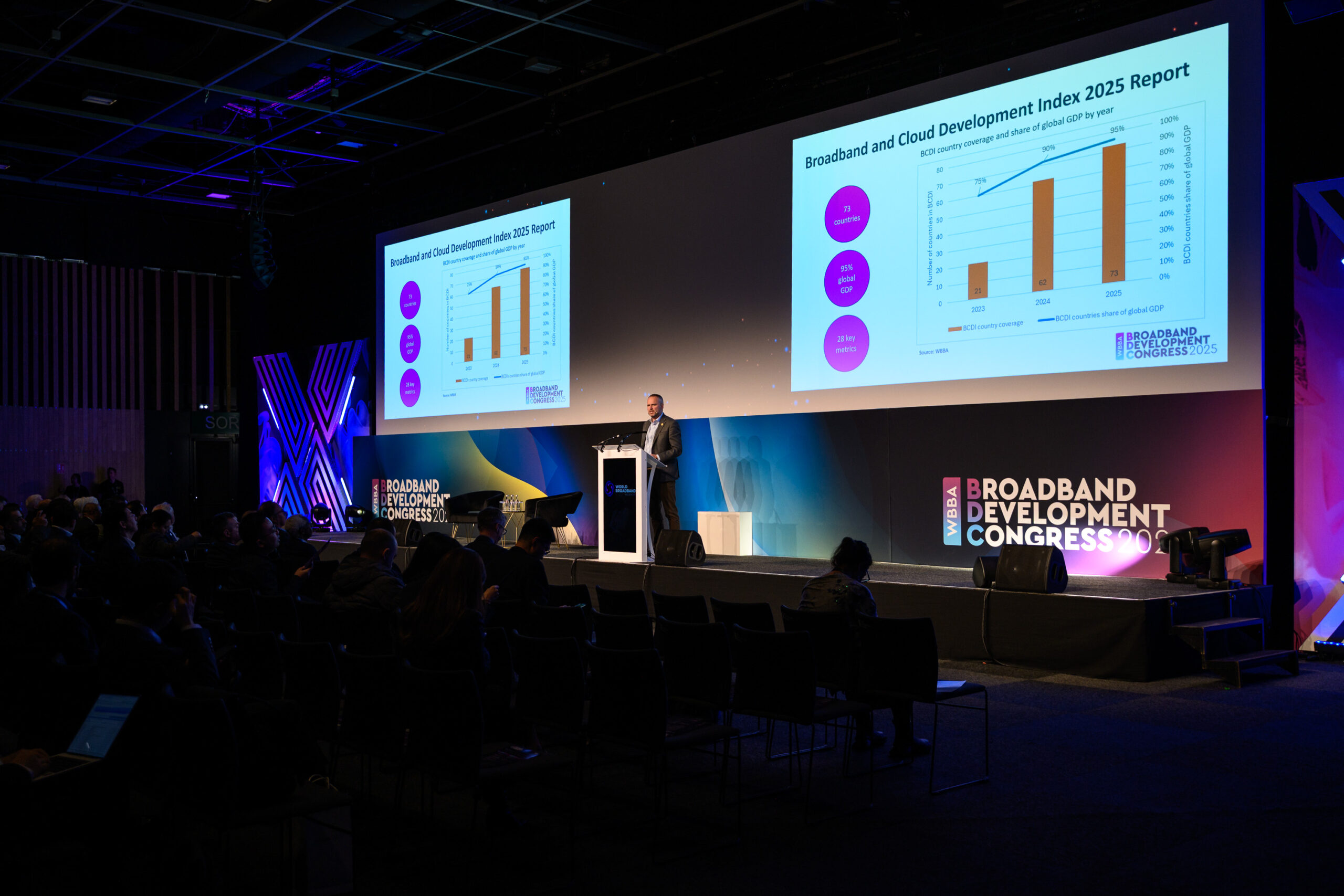
At BDC in Paris, France, the updated Broadband and Cloud Development Index (BCDI 2025) was also presented to attendees. Assessing 73 countries which account for over 95% of the global GDP, the report qualifies and ranks the performance of fixed broadband and cloud markets to identify leaders and best practices. The report found the countries with the biggest improvement in rankings since 2024 were Italy, which moved up 14 places to rank 25th, and Switzerland, which climbed 10 paces to 12th.

As countries improve their broadband offerings, the WBBA has also published the Europe: Broadband Investment Guidebook to offer recommendations and guidance to investors and stakeholders regarding the key challenges facing the sector across the continent and how these can be overcome. It also examines the future outlook for wholesale broadband, and the opportunities this presents for operators.

Investment is also a key theme of the Fibre Development Index (FDI), which provides key benchmarks and an analysis of service development in terms of broadband speed subscriptions versus the overall quality of experience, based on Omdia’s analysis of Ookla Speedtest data. Covering countries and territories of varying sizes, demographics, and geographical profiles, the FDI details exactly how essential Gigabit broadband networks can be established for future growth and development, in an age where the digital divide in access to these high-quality services is increasing.

Additionally, as demand for ubiquitous communication grows, Voice over Wi-Fi (VoWiFi) is positioned to play a significant role in the evolution of mobile networks and in service providers’ voice service strategies. To achieve a good experience, many challenges, such as traffic competition and congestion, must be addressed. With this in mind, the WBBA has also published Test Analysis of WBBA & GSMA Voice over Wi-Fi, which details a VoWiFi proof of concept that demonstrated its quality of service even when 4G/5G cellular services are limited or absent.


To read all the whitepapers highlighted in this release, please visit the WBBA Knowledge Center on the organization’s website.

Sign Up to Receive News Updates

Membership Enquiries

[gravityform id="3" title="false"]

Testing New Form

Martin Creaner
Director General of the World Broadband Association

Martin Creaner is one of the leading strategic thinkers in the global communications industry with a successful career as an executive with Motorola and British Telecom, as well as over a decade as President and CEO of the TM Forum.

Martin currently advises the boards of a number of companies in the communications and high tech industries, ranging from up-and-coming digital economy companies, to market leaders.

Martin has been named among the 25 Most Influential People in Telecom Software by Billing World and has twice been named as one of Global Telecoms Business’ Top 100. Martin holds a Master of Business Administration from Cranfield University, Cranfield School of Management; a Master of Science in Telecommunications from the University of East Anglia; and Bachelor’s degrees in Engineering and Physics from Dublin City University and the University College Dublin, respectively.

Martin is also a recognized thought-leader on digital transformation and the trends of the emerging digital economy. His most recent book “Transforming the Telco” explains the opportunities and challenges that digital transformation presents and outlines how the Telco might navigate this difficult process.

Previous books include “Delivering the Digital Economy”, which outlines the dynamics of the digital economy, and “Frameworx Distilled” & “NGOSS Distilled”, which provide a detailed guidebook to the standards that underpin the Telecom software industry.

Martin was appointed unanimously to the role of Director General by WBBA members.

Martin lives in Cork, Ireland.

Li Zhengmao
Doctor of Engineering, Professor, WBBA Board Chairman

Li Zhengmao, Doctor of Engineering, Professor. He was awarded the title of “Chinese Doctors with Outstanding Contribution” by the Academic Degrees Committee of the State Council & the former State Education Commission, and granted the China Youth Science and Technology Award by the China Association for Science and Technology, and the 2017 Distinguished Industry Leader Award by IEEE; he was inducted into the 2020 IPv6 Internet Hall of Fame and enjoyed special government allowances.

Li served as Vice-Chairman of China Institute of Communications, Vice President of Internet Society of China, Vice-Chairman of the Association of Communications Across the Taiwan Straits, Vice-Chairman of All-China Environment Federation, Board member of GSM Association (GSMA), Board Director of Next Generation Mobile Networks (NGMN) Alliance, Executive Director of Global TD-LTE Initiative (GTI), Vice President of China United Communications Corporation Limited, Vice President of China Mobile Communications Corporation Limited, and President of China Telecommunications Corporation Limited.

Key Messages

Advanced cloud technology together with superior end-to-end connectivity can enable a wider and more sophisticated range of applications that can in turn drive greater innovation, efficiency, and wealth.
Both enterprises and broader industry ecosystems are actively looking at broadband’s role in enabling their digital transformation. Most respondents to the WBBA’s Thought Leadership Enterprise Survey stated that they need faster and more reliable internet to run their business applications.
Certainly, in the short to medium term, xDSL, cable modem, fixed-wireless access (FWA), and satellite are all expected to have a role in the delivery of broadband services. However, full-fiber access will always deliver the optimum experience and remains the most sustainable and cost-efficient option.
There is a danger therefore for governments to base their cost-benefit analysis on a national economic view. However, such analysis will miss all the social benefits, as well as the more local economic benefits, that advanced broadband networks can bring. Governments must take all benefits into account, including more localized ones, when creating national broadband policies.
However, future applications will not only need ultra-high-speed services but also ultra-low latency and jitter, with high levels of reliability and consistency if they are to function properly. Countries with networks that are not capable of meeting such criteria will be left behind as the world moves to the next phase of internet applications such as the “metaverse.”
Fiber networks are significantly more environmentally friendly than equivalent copper-based networks, and can help support other green initiatives such as greater working from home, the use of advanced videoconferencing, etc. Fiber-based networks also require less maintenance due to there being less active equipment in the field, and can therefore reduce operators’ operational costs.
With rollout of new access technologies like 5G and Fiber, IPv6 reached more than 30% penetration worldwide (APNIC) and is rapidly growing. IPv6 Enhanced technologies, including segment routing over IPv6, per flow monitoring and AI, enable a multitude of objects and people to be flexibly connected to the proper services, granting end-to-end quality of experience.
Based on the responses from the WBBA Thought Leadership Survey, respondents believed, on average, this coverage could be expanded to approximately 70% through private investment. It is clear that government support will be needed to get to 100%.
However, a lack of data on the available infrastructure, access to key infrastructure such as ducts and in-building networks, and a lack of understanding both internally and externally are also key barriers to further investment.
Respondents to the WBBA survey stated that a reduction in regulatory barriers, greater flexibility in partnership arrangements, copper switch-off regulations, and setting out minimum service standards for network installations, would all take priority over financial support.

Recommendations

All countries must look to maximize the potential of broadband. This means creating long-term national broadband plans that evolve around three basic phases of broadband adoption:

In order to help facilitate this evolution to advanced broadband networks, government organizations and regulators must consider:

Making the Recommendations a Reality

Operators, enterprises, vendors, regulators, and policy-makers should seek to create a collective voice, to evangelize, advocate, co-create, and partner in the drive toward the provision of ultra-broadband networks and services for all. Organizations such as the WBBA can help by influencing key stakeholders through discussion, education, and promotion. Specifically, the WBBA should aim to: