

Skip to content
News Releases
October 22, 2025
"We would like to congratulate all the winners of this year’s Broadband Excellence Awards"
Martin-headhot
Martin Creaner
Director General of the WBBA

Global broadband innovations and excellence recognized at the Broadband Excellence Awards
20251014-1751-NetworkX-aSeed-FLZ_7017
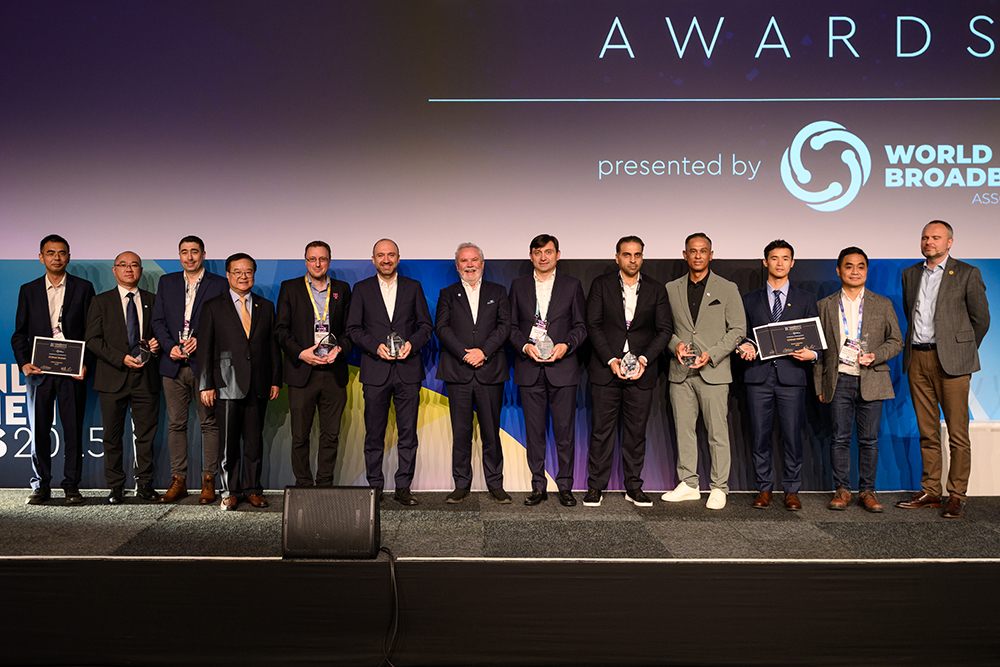
Industry leaders and innovators from across the broadband sector have been recognized at the Broadband Excellence Awards, with the winners announced today by the World Broadband Association (WBBA).

From cutting-edge infrastructure and smart city solutions, to breakthroughs in digital inclusion and sustainable connected environments, the awards – which were announced at this year’s Broadband Development Congress – highlight the pioneers building the foundation of tomorrow's gigabit societies.

“We would like to congratulate all the winners of this year’s Broadband Excellence Awards,” said WBBA Director General Martin Creaner. “All organizations, projects and technologies nominated this year are shaping the future of connectivity, driving digital transformation, and empowering communities through broadband and emerging technologies such as AI and cloud.”

T-Mobile USA were the winners of the AI in Network Excellence category, in recognition of exceptional initiative in leveraging AI applications to transform network capabilities, improve performance and support next-generation applications. The company’s submission demonstrated a commitment to pushing the boundaries of broadband networking, and laying the foundation for efficient and scalable digital ecosystems.

Within the Broadband for Digital Inclusion Excellence category, Aztelekom and Globe Telecom were joint winners for their respective ‘Online Azerbaijan’ and ‘No Filipino Left Offline – Connecting the Underserved’ submissions. Both entries reflected impactful initiatives which have successfully closed the digital divide within their regions by extending meaningful and affordable broadband access to underserved or unserved populations.

This year’s Broadband Innovation Excellence for Future Applications winner was Safaricom. The service provider’s ‘Affordable Broadband for All: Pioneering Africa’s Smart Cities Through Digital Equity and Innovation’ submission was recognized for enhancing broadband capabilities to enable emerging, high-demand digital experiences across the continent, while future-proofing broadband networks to meet the demands of next-generation content and user interaction.

China Unicom and the Intelligent Converged FTTR Terminal won the Intelligent Home Innovation Excellence Award for the solution’s ability to redefine the connected home. The telco was successful as its terminal delivers intelligent, seamless and value-added digital experiences within the home through Customer Premises Equipment and Networks (CPE/CPN).

For the Network Infrastructure Innovation Excellence Award, the judges chose China Telecom E-Surfing IoT Tech and Turkcell. Both companies evidenced outstanding advancements in broadband infrastructure that enables smarter, more inclusive and resilient digital societies.

Four nominees were awarded the Smart Gigacity Excellence Award during BDC 2025. Within the Advanced Cities subcategory, Telecom Argentina’s submission for their work in Recreo, Charata, Cafayete and Anatuya, as well as Raisecom for their Beijing project were the winners. For the Developing City subcategory, both Sunrise - for their advancements in Kenya, including Nakuru and Kiambu - and Tunisie Telecom, which was nominated for its work in Tunis, Tunisia, were awarded the prize.

Finally, stc was recognized as the Judging Panel’s Special Award, bestowed on them for the company’s outstanding achievement in Regional Giga Network developments.

For full details on all shortlisted submissions and the award categories, please visit the WBBA website.
Sign Up to Receive News Updates

Key Messages

Advanced cloud technology together with superior end-to-end connectivity can enable a wider and more sophisticated range of applications that can in turn drive greater innovation, efficiency, and wealth.
Both enterprises and broader industry ecosystems are actively looking at broadband’s role in enabling their digital transformation. Most respondents to the WBBA’s Thought Leadership Enterprise Survey stated that they need faster and more reliable internet to run their business applications.
Certainly, in the short to medium term, xDSL, cable modem, fixed-wireless access (FWA), and satellite are all expected to have a role in the delivery of broadband services. However, full-fiber access will always deliver the optimum experience and remains the most sustainable and cost-efficient option.
There is a danger therefore for governments to base their cost-benefit analysis on a national economic view. However, such analysis will miss all the social benefits, as well as the more local economic benefits, that advanced broadband networks can bring. Governments must take all benefits into account, including more localized ones, when creating national broadband policies.
However, future applications will not only need ultra-high-speed services but also ultra-low latency and jitter, with high levels of reliability and consistency if they are to function properly. Countries with networks that are not capable of meeting such criteria will be left behind as the world moves to the next phase of internet applications such as the “metaverse.”
Fiber networks are significantly more environmentally friendly than equivalent copper-based networks, and can help support other green initiatives such as greater working from home, the use of advanced videoconferencing, etc. Fiber-based networks also require less maintenance due to there being less active equipment in the field, and can therefore reduce operators’ operational costs.
With rollout of new access technologies like 5G and Fiber, IPv6 reached more than 30% penetration worldwide (APNIC) and is rapidly growing. IPv6 Enhanced technologies, including segment routing over IPv6, per flow monitoring and AI, enable a multitude of objects and people to be flexibly connected to the proper services, granting end-to-end quality of experience.
Based on the responses from the WBBA Thought Leadership Survey, respondents believed, on average, this coverage could be expanded to approximately 70% through private investment. It is clear that government support will be needed to get to 100%.
However, a lack of data on the available infrastructure, access to key infrastructure such as ducts and in-building networks, and a lack of understanding both internally and externally are also key barriers to further investment.
Respondents to the WBBA survey stated that a reduction in regulatory barriers, greater flexibility in partnership arrangements, copper switch-off regulations, and setting out minimum service standards for network installations, would all take priority over financial support.

Recommendations

All countries must look to maximize the potential of broadband. This means creating long-term national broadband plans that evolve around three basic phases of broadband adoption:

In order to help facilitate this evolution to advanced broadband networks, government organizations and regulators must consider:

Making the Recommendations a Reality

Operators, enterprises, vendors, regulators, and policy-makers should seek to create a collective voice, to evangelize, advocate, co-create, and partner in the drive toward the provision of ultra-broadband networks and services for all. Organizations such as the WBBA can help by influencing key stakeholders through discussion, education, and promotion. Specifically, the WBBA should aim to: