

Skip to content
News Releases
March 12, 2025

Focusing on Growth and Innovation: Key take-aways from WBBA’s General Assembly & Board Meeting in Barcelona
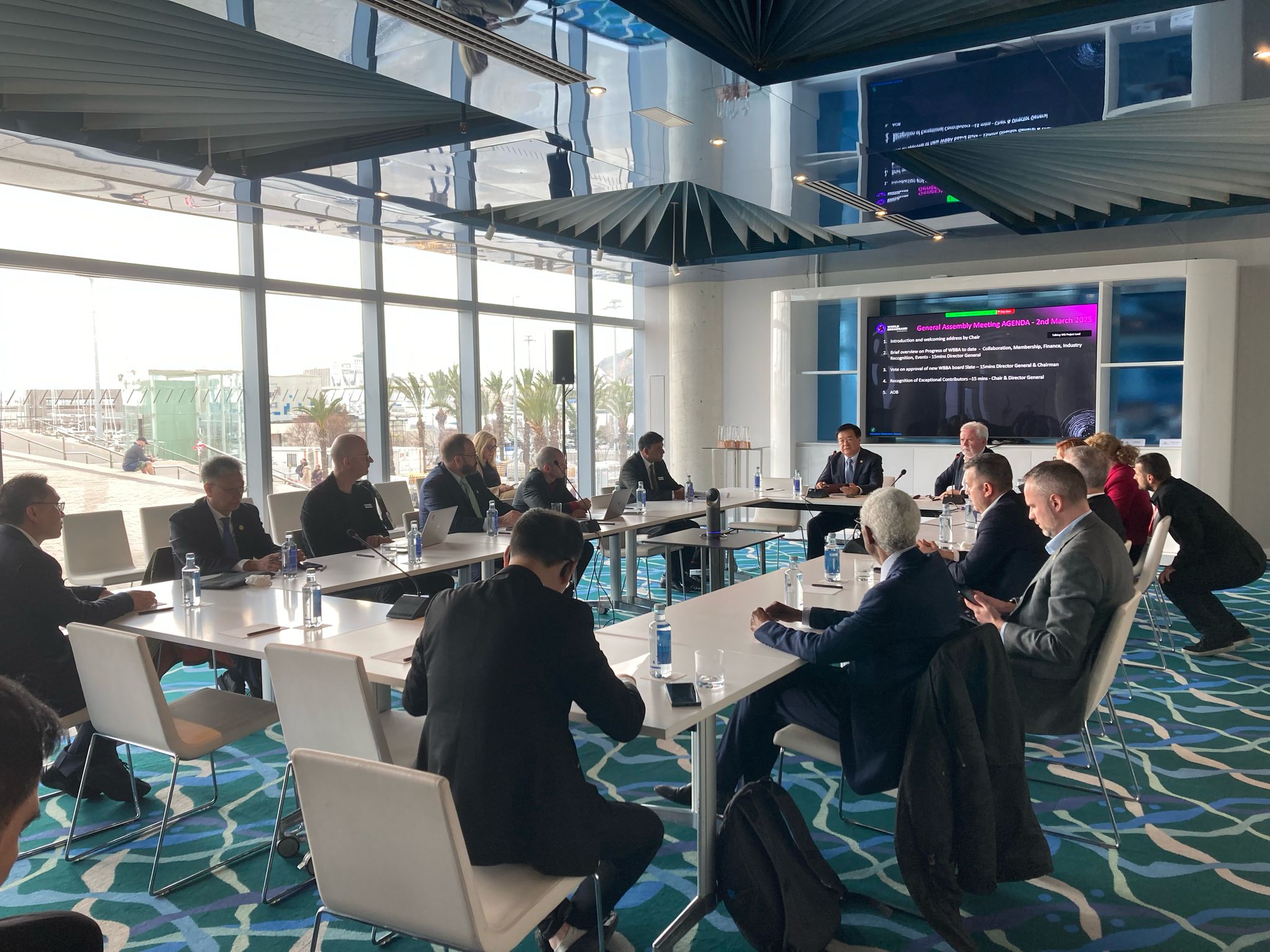
WBBA General Assembly & Board Meeting in Barcelona
The World Broadband Association (WBBA) concluded its General Assembly and Board Meeting in Barcelona last week, just as MWC 2025 kicked off.  The meeting reflects the dedication and focus of its members to collectively overcome industry challenges and support the drive towards global broadband network and services provision for all.

Key topics on the agenda included the impressive growth in WBBA’s membership figures to over one hundred and sixty members in over fifty countries, along with a focus on industry research and analysis conducted by WBBA working groups led by member experts. Topics cover: Environmental Sustainability, Artificial Intelligence, WBBA Broadband & Cloud development along with Broadband advocacy.

Dr Li Zhengmao, WBBA Board Chairman and Martin Creaner, WBBA Director General took this opportunity to welcome 4 new board members: Globe Telecom from the Philippines, ZTE from Hong Kong, Turkcell from Turkey and Informa from the UK. With their wealth of expertise and collective industry insights, it adds to the capabilities and influence of the WBBA.

The WBBA extends its gratitude to all members for their active participation and invaluable contributions to the success of the last twelve months. Their dedication and commitment are essential in shaping the future of broadband technology and driving positive change on a global scale.

WBBA objective is to overcome industry challenges and support the drive towards the provision of broadband & cloud networks and services for all. We aim to accelerate the healthy development of the industry, while generating sustainable benefits for stakeholders, end users, and society.

For those interested in joining the WBBA and contributing to its mission, we encourage you to register your interest and become part of a dynamic community dedicated to advancing broadband technology for the benefit of all. Together, we can shape a brighter future powered by connectivity and innovation.

Sign Up to Receive News Updates

Key Messages

Advanced cloud technology together with superior end-to-end connectivity can enable a wider and more sophisticated range of applications that can in turn drive greater innovation, efficiency, and wealth.
Both enterprises and broader industry ecosystems are actively looking at broadband’s role in enabling their digital transformation. Most respondents to the WBBA’s Thought Leadership Enterprise Survey stated that they need faster and more reliable internet to run their business applications.
Certainly, in the short to medium term, xDSL, cable modem, fixed-wireless access (FWA), and satellite are all expected to have a role in the delivery of broadband services. However, full-fiber access will always deliver the optimum experience and remains the most sustainable and cost-efficient option.
There is a danger therefore for governments to base their cost-benefit analysis on a national economic view. However, such analysis will miss all the social benefits, as well as the more local economic benefits, that advanced broadband networks can bring. Governments must take all benefits into account, including more localized ones, when creating national broadband policies.
However, future applications will not only need ultra-high-speed services but also ultra-low latency and jitter, with high levels of reliability and consistency if they are to function properly. Countries with networks that are not capable of meeting such criteria will be left behind as the world moves to the next phase of internet applications such as the “metaverse.”
Fiber networks are significantly more environmentally friendly than equivalent copper-based networks, and can help support other green initiatives such as greater working from home, the use of advanced videoconferencing, etc. Fiber-based networks also require less maintenance due to there being less active equipment in the field, and can therefore reduce operators’ operational costs.
With rollout of new access technologies like 5G and Fiber, IPv6 reached more than 30% penetration worldwide (APNIC) and is rapidly growing. IPv6 Enhanced technologies, including segment routing over IPv6, per flow monitoring and AI, enable a multitude of objects and people to be flexibly connected to the proper services, granting end-to-end quality of experience.
Based on the responses from the WBBA Thought Leadership Survey, respondents believed, on average, this coverage could be expanded to approximately 70% through private investment. It is clear that government support will be needed to get to 100%.
However, a lack of data on the available infrastructure, access to key infrastructure such as ducts and in-building networks, and a lack of understanding both internally and externally are also key barriers to further investment.
Respondents to the WBBA survey stated that a reduction in regulatory barriers, greater flexibility in partnership arrangements, copper switch-off regulations, and setting out minimum service standards for network installations, would all take priority over financial support.

Recommendations

All countries must look to maximize the potential of broadband. This means creating long-term national broadband plans that evolve around three basic phases of broadband adoption:

In order to help facilitate this evolution to advanced broadband networks, government organizations and regulators must consider:

Making the Recommendations a Reality

Operators, enterprises, vendors, regulators, and policy-makers should seek to create a collective voice, to evangelize, advocate, co-create, and partner in the drive toward the provision of ultra-broadband networks and services for all. Organizations such as the WBBA can help by influencing key stakeholders through discussion, education, and promotion. Specifically, the WBBA should aim to: