


Skip to content
News Releases
December 6, 2024
"During the forum speech session, Thorsten Hülsmann, Director General of IDSA , gave a speech entitled "Towards a global standard for interoperable data spaces with trust", interpreting the theory, standard setting, application scenarios, etc. of international data spaces."
1695158381227
Thorsten Hülsmann,
Director General of IDSA

China Telecom officially joins IDSA and jointly establishes the "International Carrier Data Space Working Group" with WBBA
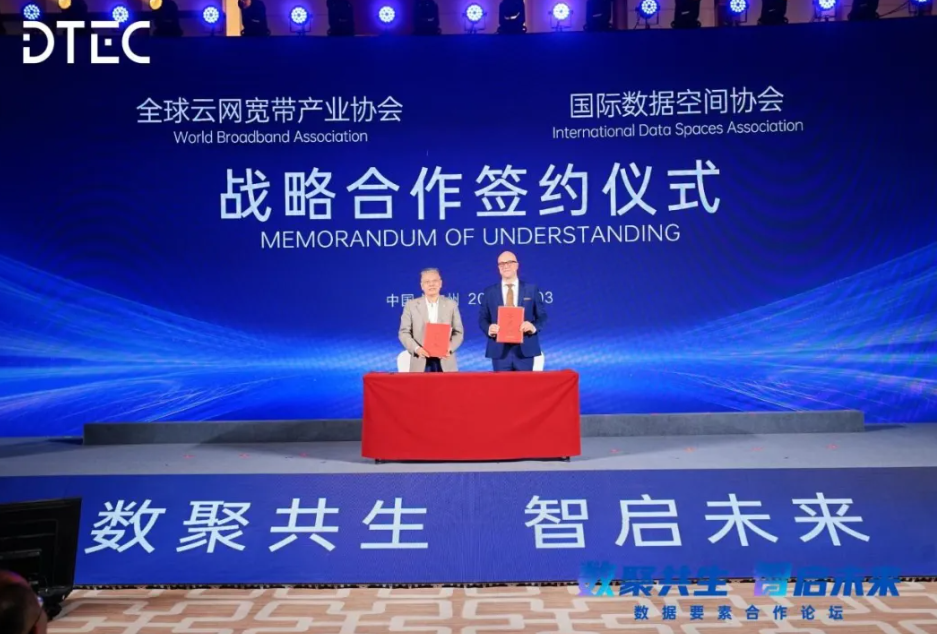
Screenshot 2024-12-06 105107
On December 3, the 2024 Digital Technology Ecosystem Conference Data Elements Cooperation Forum with the theme of "Digital Gathering, Coexistence and Intelligent Future" was held in Guangzhou, China.

During the forum, IDSA (International Data Space Association) and WBBA (World Broadband Association) signed a strategic cooperation agreement.China Telecom officially joined IDSA (International Data Space Association) and jointly established the "International Operator Data Space Working Group "with China Telecom and WBBA  to jointly promote global data space cooperation and innovative development. Li Jun, Deputy General Manager of China Telecom Group Co., Ltd., Xiong Xiong, Deputy Director of the Guangdong Provincial Government Service and Data Administration Bureau, Shan Zhiguang, Director of the Information Technology and Industrial Development Department of the National Information Centre of the National Development and Reform Commission, and Han Qi, Deputy Director of the Planning Division of the Policy and Planning Department of the National Data Administration, attended the forum and delivered speeches. More than 600 guests from more than 100 units including provincial and municipal data management departments, enterprises, universities and scientific research institutions across the country attended the meeting.

Thorsten Hülsmann, Director General of IDSA  , Liu Zhiyong, Deputy Chief Engineer of China Telecom and Rotating Chairman of the Executive Committee of WBBA , and Zhang Xin, Deputy Director (in charge of work) of Data Development Centre of China Telecom, attended the relevant ceremony on site.

During the forum speech session, Thorsten Hülsmann, Director General of IDSA , gave a speech entitled "Towards a global standard for interoperable data spaces with trust", interpreting the theory, standard setting, application scenarios, etc. of international data spaces. He also warmly welcomed China Telecom to join IDSA and looked forward to working together to establish global standards for trusted data sharing for the world .

In the future, IDSA will firmly fulfil its mission and responsibility to promote the development of the global data space and facilitate data circulation and sharing. The IDSA China Capability Center will work hand in hand with ecological partners from all walks of life to jointly build an open data space network and prosper the data space ecosystem.
Join the WBBA on our journey 

Sign Up to Receive News Updates

Membership Enquiries

[gravityform id="3" title="false"]

Testing New Form

Martin Creaner
Director General of the World Broadband Association

Martin Creaner is one of the leading strategic thinkers in the global communications industry with a successful career as an executive with Motorola and British Telecom, as well as over a decade as President and CEO of the TM Forum.

Martin currently advises the boards of a number of companies in the communications and high tech industries, ranging from up-and-coming digital economy companies, to market leaders.

Martin has been named among the 25 Most Influential People in Telecom Software by Billing World and has twice been named as one of Global Telecoms Business’ Top 100. Martin holds a Master of Business Administration from Cranfield University, Cranfield School of Management; a Master of Science in Telecommunications from the University of East Anglia; and Bachelor’s degrees in Engineering and Physics from Dublin City University and the University College Dublin, respectively.

Martin is also a recognized thought-leader on digital transformation and the trends of the emerging digital economy. His most recent book “Transforming the Telco” explains the opportunities and challenges that digital transformation presents and outlines how the Telco might navigate this difficult process.

Previous books include “Delivering the Digital Economy”, which outlines the dynamics of the digital economy, and “Frameworx Distilled” & “NGOSS Distilled”, which provide a detailed guidebook to the standards that underpin the Telecom software industry.

Martin was appointed unanimously to the role of Director General by WBBA members.

Martin lives in Cork, Ireland.

Li Zhengmao
Doctor of Engineering, Professor, WBBA Board Chairman

Li Zhengmao, Doctor of Engineering, Professor. He was awarded the title of “Chinese Doctors with Outstanding Contribution” by the Academic Degrees Committee of the State Council & the former State Education Commission, and granted the China Youth Science and Technology Award by the China Association for Science and Technology, and the 2017 Distinguished Industry Leader Award by IEEE; he was inducted into the 2020 IPv6 Internet Hall of Fame and enjoyed special government allowances.

Li served as Vice-Chairman of China Institute of Communications, Vice President of Internet Society of China, Vice-Chairman of the Association of Communications Across the Taiwan Straits, Vice-Chairman of All-China Environment Federation, Board member of GSM Association (GSMA), Board Director of Next Generation Mobile Networks (NGMN) Alliance, Executive Director of Global TD-LTE Initiative (GTI), Vice President of China United Communications Corporation Limited, Vice President of China Mobile Communications Corporation Limited, and President of China Telecommunications Corporation Limited.

Key Messages

Advanced cloud technology together with superior end-to-end connectivity can enable a wider and more sophisticated range of applications that can in turn drive greater innovation, efficiency, and wealth.
Both enterprises and broader industry ecosystems are actively looking at broadband’s role in enabling their digital transformation. Most respondents to the WBBA’s Thought Leadership Enterprise Survey stated that they need faster and more reliable internet to run their business applications.
Certainly, in the short to medium term, xDSL, cable modem, fixed-wireless access (FWA), and satellite are all expected to have a role in the delivery of broadband services. However, full-fiber access will always deliver the optimum experience and remains the most sustainable and cost-efficient option.
There is a danger therefore for governments to base their cost-benefit analysis on a national economic view. However, such analysis will miss all the social benefits, as well as the more local economic benefits, that advanced broadband networks can bring. Governments must take all benefits into account, including more localized ones, when creating national broadband policies.
However, future applications will not only need ultra-high-speed services but also ultra-low latency and jitter, with high levels of reliability and consistency if they are to function properly. Countries with networks that are not capable of meeting such criteria will be left behind as the world moves to the next phase of internet applications such as the “metaverse.”
Fiber networks are significantly more environmentally friendly than equivalent copper-based networks, and can help support other green initiatives such as greater working from home, the use of advanced videoconferencing, etc. Fiber-based networks also require less maintenance due to there being less active equipment in the field, and can therefore reduce operators’ operational costs.
With rollout of new access technologies like 5G and Fiber, IPv6 reached more than 30% penetration worldwide (APNIC) and is rapidly growing. IPv6 Enhanced technologies, including segment routing over IPv6, per flow monitoring and AI, enable a multitude of objects and people to be flexibly connected to the proper services, granting end-to-end quality of experience.
Based on the responses from the WBBA Thought Leadership Survey, respondents believed, on average, this coverage could be expanded to approximately 70% through private investment. It is clear that government support will be needed to get to 100%.
However, a lack of data on the available infrastructure, access to key infrastructure such as ducts and in-building networks, and a lack of understanding both internally and externally are also key barriers to further investment.
Respondents to the WBBA survey stated that a reduction in regulatory barriers, greater flexibility in partnership arrangements, copper switch-off regulations, and setting out minimum service standards for network installations, would all take priority over financial support.

Recommendations

All countries must look to maximize the potential of broadband. This means creating long-term national broadband plans that evolve around three basic phases of broadband adoption:

In order to help facilitate this evolution to advanced broadband networks, government organizations and regulators must consider:

Making the Recommendations a Reality

Operators, enterprises, vendors, regulators, and policy-makers should seek to create a collective voice, to evangelize, advocate, co-create, and partner in the drive toward the provision of ultra-broadband networks and services for all. Organizations such as the WBBA can help by influencing key stakeholders through discussion, education, and promotion. Specifically, the WBBA should aim to: